

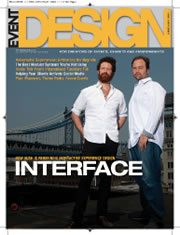
Event Design Magazine -- June/July 2011
I don’t know how many of you receive Event Design Magazine (www.eventdesignmag.com), but there is an excellent interview with Sue Huff, Director of Global Conventions for Medtronic, in the June/July 2011 issue, Best Practices column.
Normally, I’d simply link to the article, but it’s not on the Event Design website yet. Instead, I encourage you to read the interview if you have the print edition (pg. 16-17), and for those who do not have the issue, I’ve retyped several of her responses below. If I get in trouble with the folks from Event Design . . . well I’m sure they’ll let me know.
From the article:
Sue Huff manages more than 75 of Medtronic’s exhibition programs across all of the company’s U.S. businesses as well as its Pan-European programs . . . . Here, she talks to designers about the keys to creating global consistency, the evolution of social media and virtual events and overcoming cost containment challenges.
Event Design: What are some of the biggest trends affecting the trade show industry today?
Sue Huff: In general, I’m seeing social networking and virtual events used in combination with the convention environment. However, virtual has still not caught on in the healthcare industry like it has in other industries, perhaps because it’s important for physicians to be able to talk face-to-face about tough cases. We’re also seeing the show floor decreasing in size because companies are cutting back. At Event Marketing Summit last year, there was a lot of discussion about moving off the show floor with proprietary events, however, this is not common in the healthcare space.
Event Design: What is the biggest hurdle at U.S. trade shows today?
Sue Huff: Cost containment is the biggest challenge. With the recent economy, it’s more and more challenging and that’s why we’re seeing decreasing exhibit space. Exclusive service costs continue to rise, at a time when we’re looking at cutting costs. These costs are controlled by the show organizer and their selected vendors. For example, 63 percent of our convention budges are controlled and negotiated by the show organizer, and we have no control over these costs other than to decrease our size, or bring less (weight) to the show.
Event Design: Is social media having any impact on how you execute at shows?
Sue Huff: We use Twitter, Facebook and virtual technology. These channels can communicate what’s going on in the exhibit at a particular time, help us learn what the competition is doing and hear what people are saying, or what topics are of interest to show goers. I see this channel in combination with the face-to-face event increasing over time. Face-to-face is still a very important component for the healthcare industry. We’re also seeing more shows offering some type of virtual/web experience through the organizer.
Event Design: How would you like to see the trade-show world evolve?
Sue Huff: There’s still a value to face-to-face but the world is evolving with social media and I would like to continue to see how that’s integrated, but not as a replacement for live events. As the younger generation gets older, they’re just more comfortable with it, so it’s going to to continue to evolve. I would also like to see exhibitors more in control over their costs. I’m not in control of over 63 percent of my costs other than to increase or decrease exhibit size. Signing an exhibit space contract when true labor and the drayage rates are unknown is not OK. We need to know what we’re signing up for. I was recently discussing this model with an industry peer, and we agreed, it’s a flawed model. Normally, when you want to buy a service, you go out and get a bid from various vendors, review the responses, decide which vendor you’re going to work with, negotiate pricing, the vendor then provides the service and you pay the vendor. But today, the entire middle section of this model is missing and broken in our industry. To try and explain drayage to a marketing or finance partner is not possible, because it doesn’t make sense. I would like to see this industry healthy, which means the business model must change.
For the complete interview, please read the print edition, or be patient and it will appear online at Event Design sometime in July.
–Mel White
http://www.linkedin.com/in/melmwhite
mel@classicexhibits.com
*********************************
Based in Portland, Oregon, Classic Exhibits Inc. designs and manufacturers portable, modular, and custom-hybrid exhibit solutions. Classic Exhibits products are represented by an extensive distributor network in North America and in select International markets. For more information, contact us at 866-652-2100.